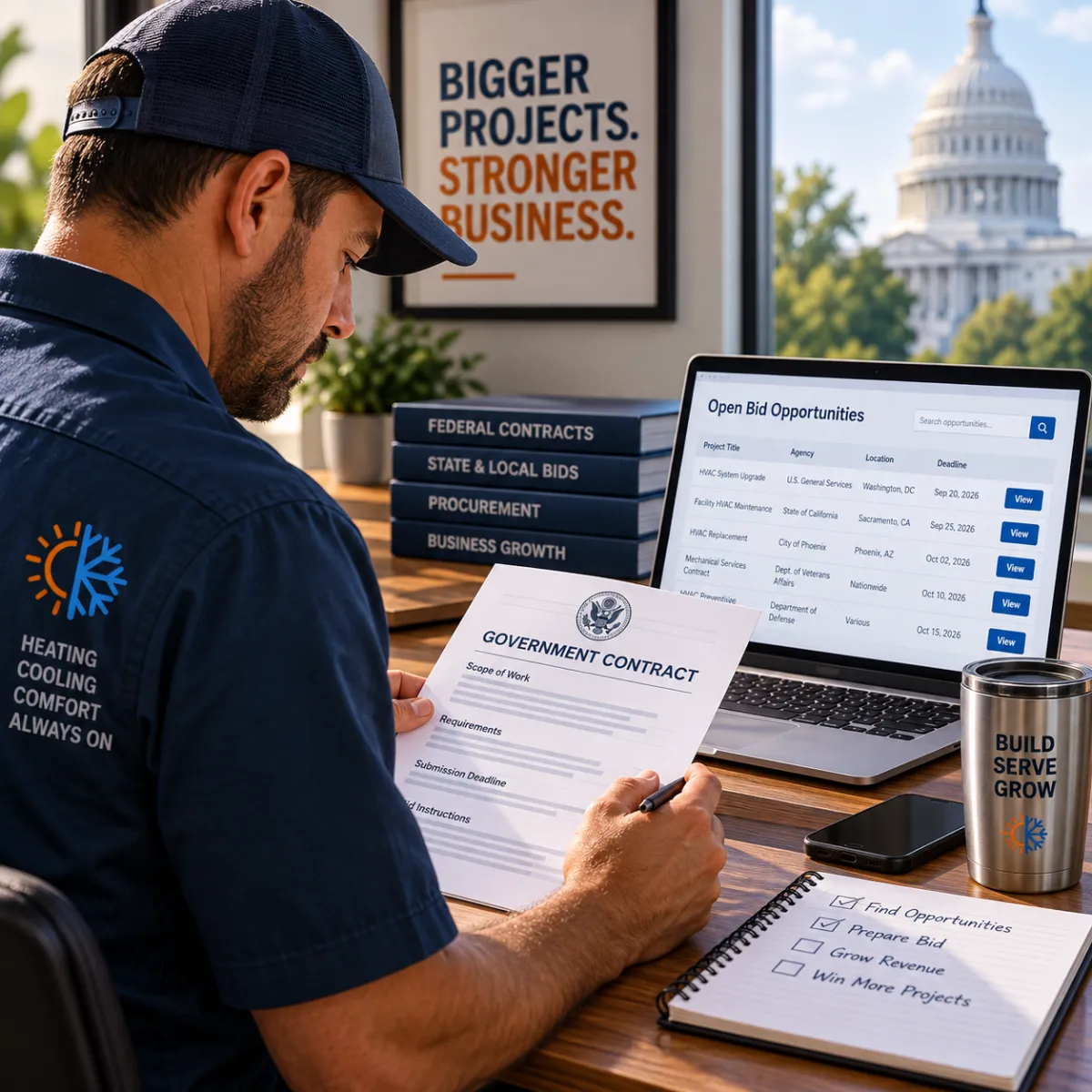
The Government Buyer Nobody's Chasing
HVAC contracts are posted every week by federal, state, and local buyers. Most small contractors have never looked
Ask most HVAC business owners about government contracts and the reaction is usually some version of "that's not for someone my size." It sounds like a world built for massive companies with compliance departments and federal relationships — not a 15-truck operation trying to keep the schedule full through a slow season. That assumption is mostly wrong, and it's an expensive one.
The Volume Is Real, and It's Not Just Federal
Open HVAC work gets posted constantly. Search SAM.gov's Contract Opportunities for "HVAC" and you'll see federal notices from agencies across the country, and the list changes every day. The exact count depends on how you filter by category and location, which is why different trackers show very different totals. What matters for a small shop is the flow: new postings week after week from federal, state, and local buyers.
Federal agencies like the Department of Veterans Affairs and the Department of Defense post HVAC maintenance and replacement work regularly. But federal work is only part of the picture. Local governments, school districts, housing authorities, and municipal facilities post HVAC maintenance and installation bids constantly, and those often carry far less red tape than a federal contract does.
Why Small Shops Assume They're Locked Out
The federal government actually works against that assumption, not for it. Congress has set a goal that 23% of federal prime contracting dollars go to small businesses, and in fiscal year 2025 agencies awarded nearly 28%, about $179 billion, according to the SBA's scorecard. There are also set-aside programs, contracts legally reserved for small businesses, veteran-owned businesses, and other qualifying categories, that exist precisely so larger firms can't crowd out smaller ones.
Large prime contractors on bigger contracts, generally those expected to exceed $900,000 ($2 million for construction) with subcontracting possibilities, must submit a small business subcontracting plan. That makes them a second entry point: they need smaller firms for pieces of the work, and you don't have to win a bid against a national player to get in.
The Real Barrier Isn't Size — It's Process
The honest reason most small HVAC shops never bid isn't eligibility. It's that finding the right opportunity among thousands of postings, understanding the bid requirements, and writing a compliant proposal is unfamiliar territory that competes for time against running the actual business.
SAM.gov is the primary hub for federal notices, and it's genuinely comprehensive — which is part of the problem. Most of what's listed isn't relevant to a given HVAC business's size, location, or certifications. Sorting the noise from the two or three postings a month that actually fit takes a process most owners haven't built.
The practical starting point that gets overlooked most often: subcontracting and local municipal bids. Winning a smaller local contract builds the "past performance" history that makes a business a credible bidder on larger work later. It's a bridge most owners skip entirely because they go straight to imagining a federal contract and decide it's out of reach.
Why This Belongs in a Revenue Conversation at All
Government work isn't glamorous, and it's rarely the fastest-closing job on the books. But it has one property that residential work doesn't: it isn't tied to a homeowner's mood, financing decision, or whether they saw a Google ad this month. A facility that needs HVAC maintenance needs it on a schedule, contractually, regardless of what the broader market is doing.
For a business dealing with the same seasonal swings and slow-market pressure every HVAC contractor faces, that's a genuinely different kind of revenue — steadier, less dependent on lead generation, and largely uncontested because most competitors never bother to look.
There's also an operational truth worth being honest about: the same habits that determine whether a business recovers the revenue already sitting in its own pipeline — consistent follow-up, reliable response times, nothing falling through the cracks — are exactly what a government buyer expects from a vendor they're trusting with a multi-year facilities contract. A business that's inconsistent about calling leads back isn't going to suddenly become consistent because the buyer wears a badge.
The Real Question Right Now
Have you ever actually searched SAM.gov, or your state and county procurement portals, for HVAC opportunities in your service area — or has "that's not for a business my size" simply never been tested? It's worth fifteen minutes to look, if only to find out whether the assumption holds up.
If you want a second set of eyes on where your business is consistent and where it isn't — because that's exactly what determines whether new revenue, government or otherwise, actually sticks — the Revenue Diagnosis takes about 15 minutes and shows you exactly where estimates, dead leads, and follow-up gaps are sitting in your pipeline right now — no pitch, just the numbers.
Want to see what revenue recovery looks like with real numbers? See how a Revenue Diagnosis works, or read about the full revenue recovery system.
Get your free Revenue Diagnosis →https://calendly.com/vince-odn/discovery-call